






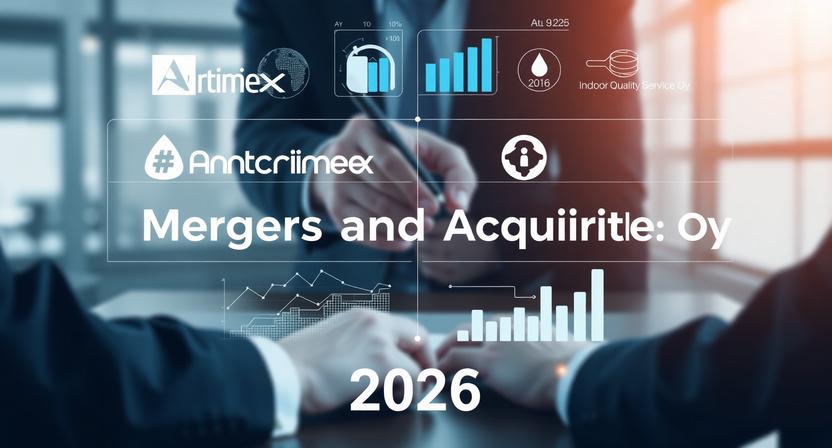
Mergers and acquisitions (M&A) remain a cornerstone of growth strategies in fragmented service industries. The 2026 acquisition of Indoor Quality Service Oy by Anticimex Oy exemplifies how strategic consolidation can strengthen market positioning, expand service capabilities, and create long-term value. This blog post analyzes the strategic rationale, execution approach, and implications of this transaction within the broader M&A framework.
Industry Context: Fragmentation and Consolidation
The pest control and indoor environmental services industry is highly fragmented, characterized by numerous small and medium-sized enterprises operating in local markets. This fragmentation creates ideal conditions for consolidation strategies led by larger firms.
Anticimex, a global leader in preventive pest control and related services, has aggressively pursued an acquisition-led growth strategy. Since 2015, the company has completed hundreds of acquisitions, expanding its presence across multiple continents while maintaining steady organic growth. ()
The industry’s attractiveness lies in:
- Recurring revenue models (service contracts)
- Non-cyclical demand
- Increasing regulatory and hygiene standards
- Growing awareness of indoor environmental quality
These factors make acquisitions not just a growth tool, but a competitive necessity.
Strategic Rationale Behind the Acquisition
1. Market Consolidation and Local Dominance
The acquisition of Indoor Quality Service Oy aligns with Anticimex’s broader strategy of consolidating local markets. By acquiring established local players, Anticimex can:
- Increase market share in Finland
- Reduce competition
- Strengthen regional density
This “buy-and-build” approach enables economies of scale while preserving local expertise.
2. Service Portfolio Expansion
Indoor Quality Service Oy likely brought complementary capabilities in indoor environmental quality, such as air quality monitoring or hygiene services. This enhances Anticimex’s value proposition by:
- Offering integrated solutions
- Cross-selling services to existing clients
- Increasing customer lifetime value
Such capability expansion is critical in moving from traditional pest control to holistic environmental management.
3. Synergy Creation
Synergies in this acquisition can be categorized as:
- Operational synergies: Shared infrastructure, logistics, and technology platforms
- Cost synergies: Procurement efficiencies and reduced overhead duplication
- Revenue synergies: Cross-selling and bundled service offerings
Anticimex’s historical focus on integration rather than replacement ensures that acquired firms retain their operational strengths while benefiting from group-level efficiencies. ()
4. Technology and Innovation Integration
Anticimex is known for its digital pest control solutions (e.g., SMART technology systems). Acquiring firms like Indoor Quality Service Oy provides:
- New platforms for deploying digital solutions
- Opportunities to standardize innovation across markets
- Enhanced data collection and predictive service capabilities
M&A Strategy Framework: Anticimex Model
Anticimex’s acquisition strategy can be summarized into four key pillars:
1. High-Frequency Acquisitions
Rather than relying on large, transformational deals, Anticimex executes numerous small-to-mid-sized acquisitions. This reduces risk while maintaining consistent growth momentum.
2. Decentralized Integration
The company emphasizes cultural and operational continuity:
- Local management is often retained
- Brand value and customer relationships are preserved
- Integration focuses on systems and processes, not identity
3. Long-Term Value Creation
Backed by long-term investors, Anticimex prioritizes sustainable growth over short-term financial engineering. This approach allows for:
- Continuous reinvestment
- Strategic patience in integration
- Innovation-driven expansion ()
4. Geographic Expansion with Density Strategy
The company expands geographically while simultaneously building density within existing markets. This dual strategy enhances:
- Route efficiency
- Customer proximity
- Competitive barriers
Integration Challenges and Risks
Despite its strengths, the acquisition presents several challenges:
Cultural Integration
Maintaining local identity while aligning with corporate standards requires careful balance. Mismanagement can lead to employee disengagement or customer attrition.
Operational Alignment
Differences in systems, processes, and service standards must be harmonized without disrupting ongoing operations.
Over-Acquisition Risk
A high volume of acquisitions can strain management capacity and dilute strategic focus if not carefully controlled.
Strategic Outcomes and Implications
The Anticimex–Indoor Quality Service Oy deal reflects broader trends in the industry:
- Shift Toward Integrated Environmental Services
Companies are moving beyond pest control into comprehensive indoor quality solutions. - Platform-Based Growth Models
Firms like Anticimex act as platforms, acquiring and integrating smaller players into a unified ecosystem. - Competitive Moats Through Scale and Technology
Scale, combined with digital innovation, creates barriers for smaller competitors.
Lessons for M&A Strategy
This case highlights several key lessons:
- Fragmented industries favor roll-up strategies
- Integration approach determines long-term success
- Technology can amplify acquisition value
- Local expertise remains critical even in global firms
Conclusion
The 2026 acquisition of Indoor Quality Service Oy by Anticimex Oy illustrates a well-executed, strategy-driven M&A approach in a fragmented and growing industry. By focusing on consolidation, capability expansion, and thoughtful integration, Anticimex continues to strengthen its position as a global leader.
Ultimately, this case demonstrates that successful M&A is not just about acquiring companies—it is about building a scalable, innovative, and resilient business ecosystem.